Published by Latham’s Steel Security Doorsets Ltd. This is our own guide to the buying criteria that matter, and how we perform against them.
Choosing a steel security door supplier is rarely about the door alone. For contractors, installers and specifiers, the decision comes down to a handful of things that actually decide whether a specification works on site: lead time, fire and security certification, locking specification, colour and finish options, and whether the price you are quoted is the price you pay.
This guide sets out those criteria, explains why each one affects your job and provides you with questions to ask your chosen supplier before ordering.
- What to look for in a steel security door supplier
- Why contractors and specifiers choose Latham's
- Key terms
- Frequently Asked Questions
What to look for in a steel security door supplier
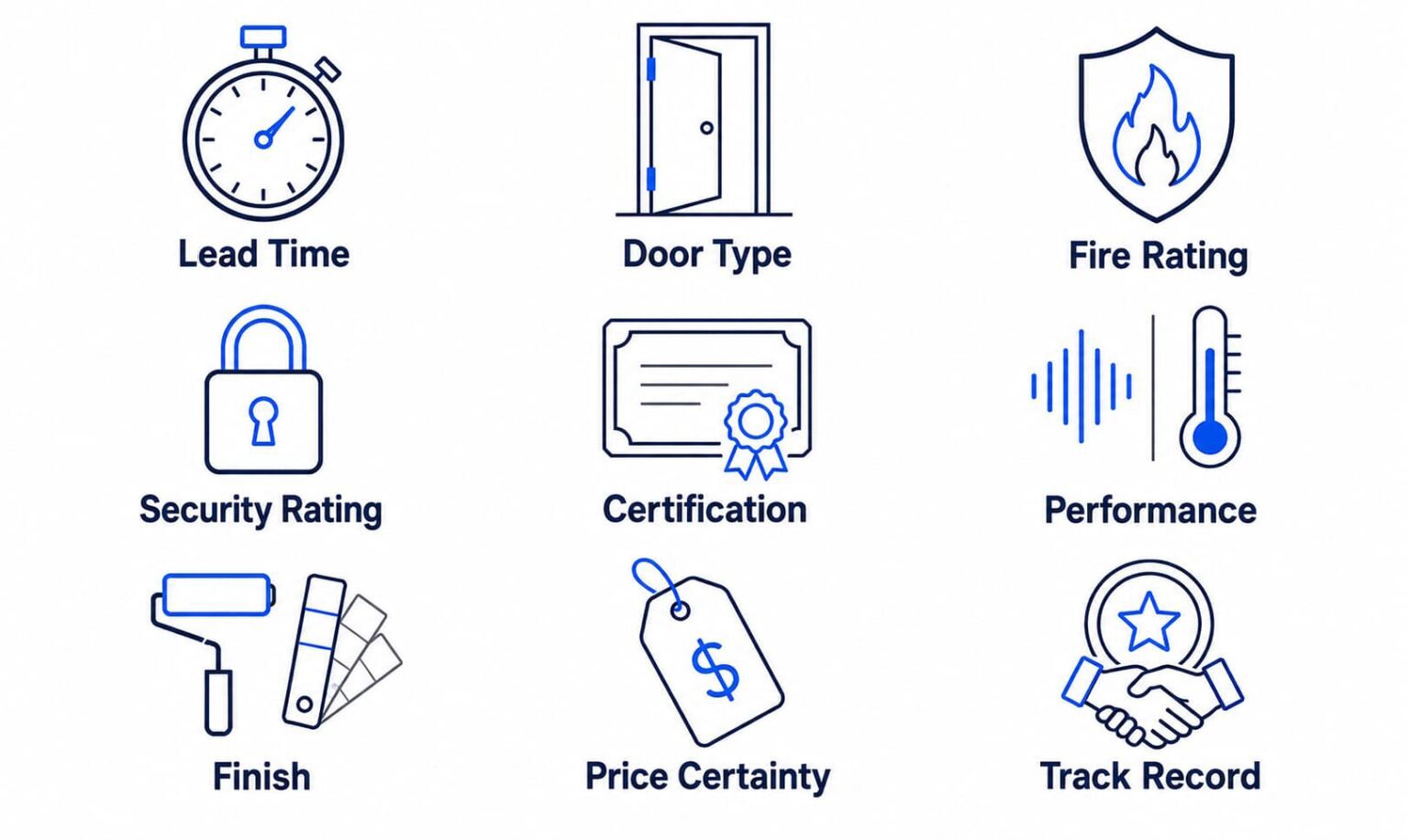
The nine criteria below decide whether a door specification succeeds on site.
1. Lead time and stock availability
A door held in stock ships in days. A door built to order ships in weeks. On a live project, that difference can decide whether you hit a handover date.
Latham’s holds over 14,000 steel doors in stock for standard structural openings, with delivery in 1 to 3 working days on the six stock colours. Any other RAL colour is produced in up to 10 working days through our in-house powder coating facility, so a non-standard finish does not push you into a multi-week wait.
On site: This is the difference between a plant room left open behind temporary hoarding for three weeks and a door fitted before the next trade arrives. If a doorset is damaged on delivery or an opening is re-measured late, a supplier shipping from stock can replace it inside the week. A built-to-order supplier restarts the clock.
What to ask any supplier:
How many doors do you hold in stock? What is your delivery time on a stock door, and on a non-stock colour?
2. Fire rating
Fire rating is a compliance requirement, not an upgrade. The rating you specify has to match the fire strategy for the opening, and the certification has to be evidenced, not asserted.
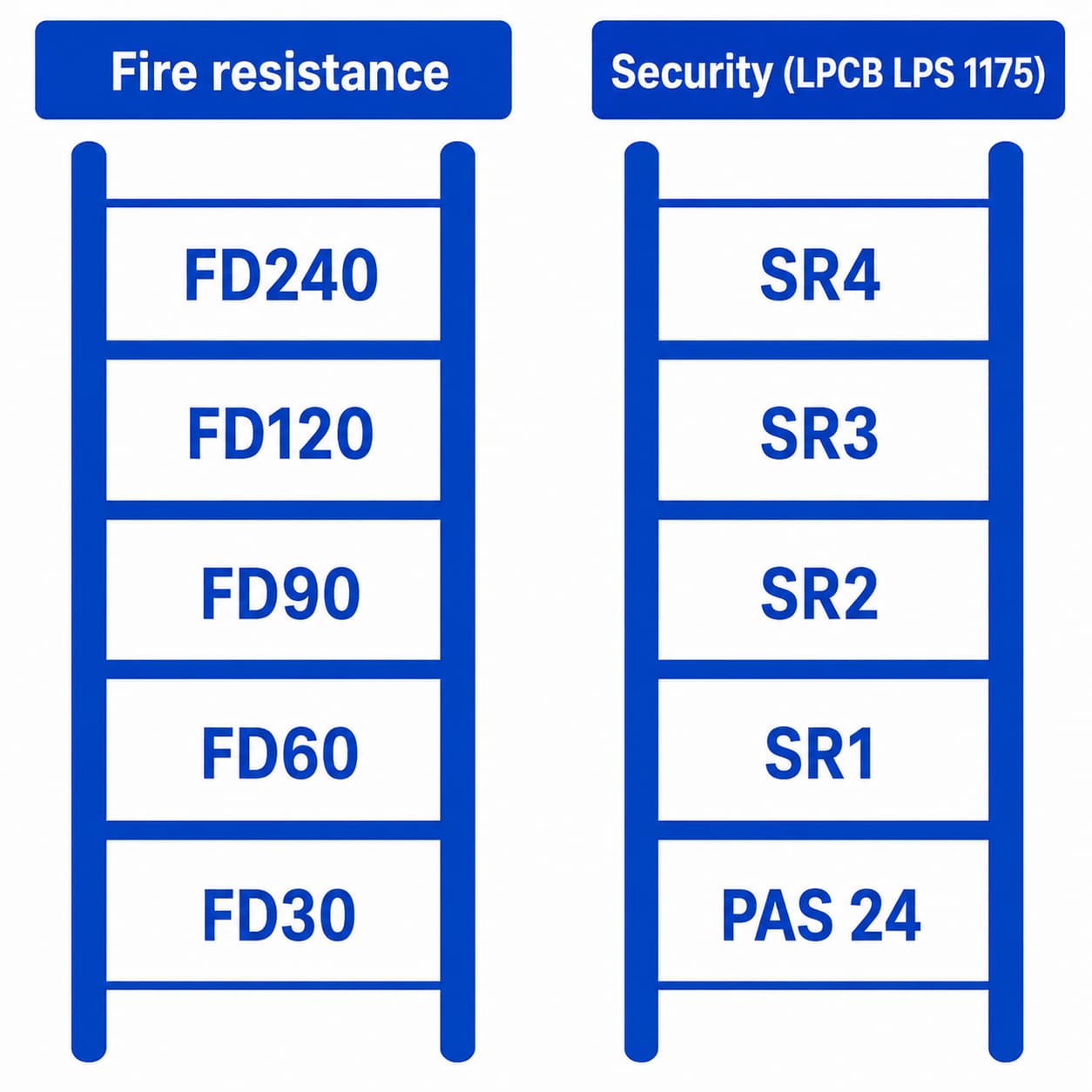
Latham’s supplies doors fire rated from FD30 to FD240, covering standard fire exits through to 240-minute certified doorsets. Depending on the fire rating required, these doors may need to be made-to-measure, so lead times might be longer than for Latham’s usual stock products.
On site: The rating is only as good as the evidence behind it. A door described as FD60 should come with third-party certification (for example Certifire or a Q-Mark scheme) and a tested doorset specification covering the leaf, frame, intumescent seals and hardware as a single assembly. Mixing a certified leaf with uncertified hinges or closers can void the rating, and that is exactly what a building control inspector or fire risk assessor will check.
What to ask any supplier:
What fire ratings can you certify, is the certification third-party verified, and does it cover the whole doorset rather than just the leaf?
3. Security rating
Security rating tells you how the doorset performs against forced entry. Specifications commonly call for PAS 24, or an LPCB SR rating from SR2 to SR4 for higher-risk sites.
Latham’s supplies doors rated from PAS 24 up to SR4, and holds Secured by Design accreditation. The locking specification is the HOOPLY 19-point system as standard, and we are an official HOOPLY partner.
On site: The two scales are not interchangeable. PAS 24 is an enhanced-security standard common on commercial and residential openings; LPCB‘s Loss Prevention Standard 1175 (the SR ratings) measures resistance against progressively more determined manual attack, and insurers or specifiers on plant, utility and data sites often name a specific SR level. It’s worth checking whether the locking that delivers the rating is fitted as standard or charged as an upgrade, because that is where quotes diverge.
What to ask any supplier:
What is the highest security rating you can certify, and what locking system is fitted as standard rather than as a paid upgrade?
4. Door type and configuration
Before any rating matters, the door has to fit the opening and do the job. Type and configuration are the first filter, and the one most likely to push you from a stock item into a bespoke lead time.
Latham’s stock range covers standard single and double-leaf doorsets for common structural openings. Vision panels, louvre panels for ventilation, and fire-exit hardware such as panic and emergency exit devices are specified to suit the opening and its use, and are also available on very fast lead times from Latham’s.
On site: A single personnel door in a warehouse is in an entirely different league to a double-leaf set with a 300mm louvre for a plant room, or a door needing a glazed vision panel for a corridor sightline. Each addition (vision panels, louvre panels, panic hardware, side panels) can change both the certification and the lead time, so it’s important to confirm the full configuration against the stock range early rather than discovering a bespoke item at order stage.
What to ask any supplier:
Which configurations are in your stock range, and which push the order into a bespoke build? Can vision panels, louvres and exit hardware be added without affecting the fire or security certification?
5. Certification and compliance evidence
A rating is a claim. Certification is the proof. On any specified job, the paperwork has to stand up to building control, the fire risk assessor and, increasingly, the client’s own compliance team.
Latham’s doorsets are supplied with the certification appropriate to the specified fire and security ratings, including Secured by Design accreditation across qualifying products.
On site: Look for UKCA or CE marking as applicable (CE marking remains accepted for construction products in Great Britain), the relevant BS EN test references, and third-party certification scheme membership rather than a self-declared rating. Ask whether you receive a Declaration of Performance and an installation specification, because a tested doorset only performs to its rating if it is installed to the same specification it was tested under. Keep these documents. The golden thread duty under the Building Safety Act applies specifically to higher-risk buildings (broadly, those 18 metres or seven storeys and above with at least two residential units), but retaining this evidence for the life of the building is increasingly treated as best practice more widely and expected by insurers and compliance teams.
What to ask any supplier:
Do you provide third-party certification, a Declaration of Performance, and an installation specification with the doorset? Is the product UKCA or CE marked?
6. Performance ratings: acoustic, thermal and weather
Fire and security are the headline ratings, but external openings and noise-sensitive spaces carry their own requirements. Missing one of these at specification stage is a common cause of a door being rejected after delivery.
Latham’s can advise on the appropriate acoustic, thermal and weather performance for an opening and specify a doorset to suit. Be careful to confirm the exact figures required for your opening so the right specification is supplied.
On site: An external door on a heated building may need a U-value to meet Part L, a weather rating (air permeability, water tightness and wind resistance) for an exposed elevation, and an acoustic rating (Rw, in decibels) where it separates a plant room from occupied space. These are separate tests from the fire and security ratings. A door can be FD60 and SR3 yet still fail an acoustic or thermal requirement, so list every performance requirement for the opening up front.ol inspector or fire risk assessor will check.
What to ask any supplier:
7. Colour and finish
A door that arrives in the wrong colour, or that takes weeks to colour-match, creates the same delay as a missing door.
Latham’s offers six stock colours on a 1 to 3 day lead time, with Anthracite Grey being the most popular, and any other RAL colour through in-house powder coating in up to 10 working days. Because the coating is done in-house rather than subcontracted, lead times on non-stock colours stay short.
On site: This becomes a problem if the architect’s RAL specification does not match any supplier’s stock colour. With outsourced coating, that one line on a drawing can add weeks of delays to a project while doors are shipped out to a coater and back. In-house coating keeps it to around 10 working days, preventing long delays.
What to ask any supplier:
Is powder coating done in-house or outsourced, and what is the lead time on a non-stock RAL?
8. Price certainty
A quote that changes between order and invoice is a margin risk you carry through to your own client. Price certainty matters as much as the headline figure.
Latham’s offers trade customers an agreed price held for 12 months, exclusive to that business, alongside 30-day credit terms for approved accounts, so you are not funding the door before you invoice your own client.
On site: On a programme priced months in advance, a door price increase between tender and order comes straight out of your margin if the quote was not held. A price fixed for 12 months lets you carry the same figure from estimate to invoice, and 30-day terms mean you are not paying for the door before your own client pays you.
What to ask any supplier:
Is my quoted price fixed, and for how long? Do you offer trade credit terms?
9. Track record and support
A door is a long-term asset. The supplier’s stability, warranty and aftercare matter over the life of the product.
Latham’s has been family run since 2011, operates from a 100,000 sq ft facility with an on-site showroom, runs a nationwide delivery fleet of six vehicles, holds a 5-star Trustpilot rating, and provides a 3-year warranty across the range.
On site: Aftercare is the part you only notice when something goes wrong. A supplier running its own delivery fleet controls its own lead times rather than relying solely on a third-party carrier, and an on-site showroom means you can see and handle the product before committing it to a specification. A multi-year warranty backed by a long-trading business is worth more than the same warranty from an unknown one.
What to ask any supplier:
How long have you traded, what warranty do you provide, and can I see the product before I commit?
Why contractors and specifiers choose Latham’s
Where Latham’s tends to win is the combination of speed and certainty. Holding 14,000+ doors in stock with a 1 to 3 day delivery on stock colours means a standard opening can be specified, priced and on site inside a week. In-house powder coating keeps non-standard colours to around 10 working days rather than the longer waits that subcontracted finishing can create. The HOOPLY 19-point locking system is fitted as standard rather than charged as an upgrade. To top it off for trade customers, an agreed price held for 12 months, with 30-day credit terms for approved accounts, removes the price-creep and cash-flow risks that contractors carry on every job.
Set against the full FD30 to FD240 fire range, the PAS 24 to SR4 security range, Secured by Design accreditation, a 3-year warranty and a 5-star Trustpilot record, that is a strong position for standard commercial and industrial openings where lead time and price certainty decide the job.
Key terms
A quick reference for the ratings and standards named in this guide.
- FD30 to FD240. Fire resistance in minutes. An FD60 doorset is tested to hold back fire for 60 minutes. The number must match the fire strategy for the opening.
- PAS 24. An enhanced-security standard covering resistance to forced entry, common on commercial and residential doorsets.
- SR2 to SR4. LPCB security ratings under Loss Prevention Standard 1175. Higher numbers resist more determined and better-equipped manual attack. SR3 and SR4 are typical on plant, utility and high-risk sites.
- Secured by Design. A UK police-backed accreditation awarded to products that meet recognised security standards.
- Doorset. The leaf, frame, seals and hardware certified and supplied as a single tested assembly, rather than parts combined on site.
- UKCA marking. The UK conformity marking that shows a product meets the applicable UK regulations.
- Declaration of Performance. A document stating a construction product’s performance against the relevant standard. Often required as part of the building’s compliance record.
- U-value. A measure of heat loss through the door. Lower is better. Relevant to Part L energy requirements on heated buildings.
- Rw (acoustic). Weighted sound reduction in decibels. The higher the figure, the more sound the doorset blocks.
- RAL colour. A standardised European colour-matching system used to specify powder-coat finishes.